

Freelove (Fenner) Jenckes
(1749/1751 - 1780; died around 29 to 32 years old)
Freelove (Fenner) Jenckes, daughter of James Fenner and Freelove (Whipple) Fenner, was born on March 25, 1751 in Providence, Rhode Island (John E. Sterling's North Burial Ground lists 1749 as a birth date). Both of her parents, and her brother John, died while she was no more than two years old, John dying in 1750 at 2 days old. Freelove Fenner was celebrated for her beauty and well known for her participation in the “Daughters of Liberty,” which organized in Rhode Island in 1766. As Rhode Islanders began to resist the enactment of the Stamp Act, many women decided they were going to join the fight against perceived British tyranny. Eighteen young women collaborated at the first meeting in Providence and the organization eventually sprouted branches throughout New England.
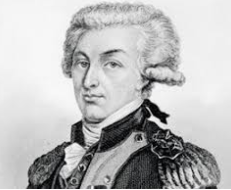
The “Daughters of Liberty” conducted and participated in boycotts of British goods in order to show their loyalty to the colonies. Members of the “Sons” and “Daughters” organizations worked together and met frequently to discuss the issues of the time. Their patriotic effort to provide “homespun” fabric and other domestic products decreased colonists’ dependence on British goods. They helped to find substitutes for products such as tea and sugar that were controlled and heavily taxed by Great Britain. Without the dedication and commitment of these women, rejection of British taxation policies would have been much more difficult, if not impossible. Freelove received recognition for her effort from the Marquis de Lafayette when he visited Providence in 1778.
Freelove Fenner married Captain Sylvanus Jenckes in 1772 and gave birth to her daughter the following year. She did not live to see the end of the war, dying in 1780.
Amanda Morgan, Student at Rhode Island College
Gallery

The burning of the British tax ship HMS Gaspee, by Rhode Islanders who launched their boats from Providence after a "discussion" at Sabin's Tavern, nearly three years (approximately 1.5 million minutes) before the Minutemen of Massachusetts fought British forces at Lexington and Concord.
Describe your image
The burning of the British tax ship HMS Gaspee, by Rhode Islanders who launched their boats from Providence after a "discussion" at Sabin's Tavern, nearly three years (approximately 1.5 million minutes) before the Minutemen of Massachusetts fought British forces at Lexington and Concord.
Freelove (Fenner) Jenckes (1751-1780)
Freelove (Fenner) Jenckes, daughter of James Fenner and Freelove (Whipple) Fenner, was born on March 25, 1751 in Providence, Rhode Island. Though of “ancient and honorable family,” both of her parents died before her first birthday. The Whipple family were among the most prominent in Providence and the Fenners possessed one of England’s oldest lineages, as the name derives from the Fens, a Celtic tribe that settled on the island prior to the arrival of the Normans, the Angles and Saxons, and the Romans. More than a millennium later, Freelove (Fenner) Jenckes' great-great-great-grandfather Captain Thomas Fenner apparently was vital in England’s defeat of the Spanish Armada in 1588.
As a young woman from a political family, Freelove Fenner (maiden name) was celebrated for her beauty and well known for her participation in the “Daughters of Liberty,” who organized themselves in Rhode Island in 1766. As Rhode Islanders began to resist the enactment of the Stamp Act, many women decided that they were going to join the fight against perceived British tyranny. Eighteen young women collaborated at the first meeting in Providence and decided that “Daughters of Liberty,” derived from the “Sons of Liberty,” would be a suitable name. Members of the organization included many young women who either were born into a politically prominent family, or married into one. The organization eventually sprouted branches throughout New England, in Massachusetts, Connecticut and in Newport and Providence.
The “Daughters of Liberty” conducted and participated in boycotts of British goods in order to show their loyalty to the colonies. Members of the “Sons” and “Daughters” organizations worked together and met frequently to discuss the issues of the time. Their patriotic efforts of providing “homespun” fabric and other domestic products decreased colonists’ dependence on British goods. They helped to find substitutes for products such as tea and sugar that were controlled and heavily taxed by Great Britain. Women’s new roles as “Daughters of Liberty” and leaders of boycotts became an integral part of the struggle against Great Britain. Without the dedication and commitment of these women, rejection of British taxation policies would have been much more difficult, if not impossible.
Freelove Fenner married Captain Sylvanus Jenckes in 1772. Jenckes captained ships for Rhode Island merchants, including John Brown’s infamous ship Sally, which Jenckes took to Suriname in January 1776 and brought back loaded with essential gunpowder and guns. In 1773 Freelove gave birth to her daughter, Sarah Whipple Jenckes, the only one of her three children to survive. Sarah later married James Fenner, her first cousin once removed, who served as U.S. senator from 1805 to 1807 and later in three separate terms as governor of Rhode Island. During his final term (1843-45) he became the first governor to serve under the new Rhode Island state constitution. Sarah and James Fenner also are buried at the North Burial Ground.
Freelove received recognition from the Marquis de Lafayette when he visited Providence in 1778. He gave her a “rosette called the tricolor, which he wore under his waistcoat, and, giving it to her, asked her not to forget him while the colors remained bright." At the end of the 19th century the token remained in the possession of her grandniece.
Freelove Whipple Fenner Jenckes did not live to see the end of the war, dying in 1780. Her husband Sylvanus died at Petersburg, Virginia in 1781, one month after Cornwallis surrendered at Yorktown. The two are buried at North Burial Ground, as are their daughter Sarah, and Sarah’s husband, James.
Amanda Morgan, Student at Rhode Island College
In the John E. Sterling book, North Burial Ground (2000), the code for Freelove Jenckes' gravestone is S (for slate composition), G (for good condition), F (for fancy top shape), U (for upright state), W (for winged creature), and G (for good legibility of script); this gravestone was carved by John Anthony Angel. Check photo link to view North Burial Ground and other texts on Rhode Island graveyards that are available for purchase. Some are available in public libraries as well.
Visiting the North Burial Ground, and referencing the Sterling book, one might start with AC 01628, which is Abigail (Brown) Whipple, whose husband was John, and whose daughter was Freelove (Whipple) Fenner. Abigail was born in 1705 and died 15 June, 1736, when her daughter, Freelove (Whipple) Fenner, was about 7 years old. Abigail's gravestone was carved by "Bleeding Heart Carver," and is slate, good condition, fancy top, upright, "M" for a "Misc. Other" carving, and with good legibility. Beside her, moving north (right to left), is her daughter, Freelove (Whipple) Fenner, whose husband was James, who was the daughter of John and Abigail, with an acanthus (Z) carving in the fancy top, and with the quite legible assertion that she died at 22 years, 3 months, and 7 days. John Anthony Angel was the carver. That much is definite. What causes confusion is that she, Freelove (Whipple) Fenner (1729 - April 21, 1751), might better be listed sequentially as AC 01629, when in fact she is listed as AC 01631. Thus, moving right to left, or generally northward, we have 01628: Abigail (Brown) Whipple; 01631: Freelove (Whipple) Fenner; and then 01630: John Fenner, Freelove (Whipple) Fenner's son who died in 1750 at 2 days old. His small stone is also a John Anthony Angel stone with "M" for a "Misc. Other" designation.
Where confusion sets in is, again moving right to left, and to the left of John, is an illegible stone which might be - should be? - 01629. Or maybe not. Further confusion is that, in the Sterling book, two people are listed as that 01629 code: The first is Captain Sylvanus Jenckes, mentioned above, and the second is his wife, Freelove (Fenner) Jenckes, the subject of this page, who was the daughter of James Fenner and Freelove (Whipple) Fenner, the sister of baby John who died in two days, the husband of Sylvanus Jenckes, and the granddaughter of Abigail (Whipple) Brown. The confusion may be mine, or may be caused by the numbers running, right to left, 01628, 01631, 01630, and (possibly, but not definitely) 01629. Is 01629 in some other place? This is possible, as there is a Fenner tomb in another section of the burial ground. The gravestone mix-up is not helped by the last stone in line being illegible, of a whiter slate, and not at all like the one you see above. What adds further confusion is that the two 01629s, Sylvanus and Freelove (Fenner) Jenckes, are listed as carved by two different tradesmen, Gabriel Allen and George Allen respectively (Brothers? Father and son?). Freelove (Fenner) Jenckes, like her mother and grandmother, died young, around the age of 32, and about a year-and-a-half later her husband, Sylvanus, died in Petersburg, Virginia, a Captain in the Continental Army in the Revolutionary War. His death date in North Burial Ground is November 25, 1781. Again, a mystery to be solved, is that the Battle of Petersburg was in April of 1781, and the seige of Yorktown, nearby, lasted from September to October of 1781. Sylvanus Jenckes apparently died after the war had concluded, and in Virginia. Was his body immediately, or ever, transferred back to Rhode Island?
David Posman, RIC student
Further Reading
Greene, Welcome Arnold. Providence Plantations for 250 Years. Providence, Rhode Island: J.A. & R.A. Reid Publishers and Printing, 1886.

Arthur Fenner: Fourth Governor of Rhode Island (after independence), 1790 - 1805; (geni.com - linked)

James Fenner: Seventh Governor of Rhode Island, 1807 - 1811; (geni.com - linked)

