

Thomas Smith Webb
(1860-1930)
Thomas Smith Webb was born in Boston, Massachusetts on October 30, 1771 to Samuel Webb and Margaret Cookson, and was one of eight children. In his early years in Boston, Webb worked as a printer’s apprentice. He continued to work in as a printer in Keene, New Hampshire and Cleveland, Ohio before he moved to Rhode Island in 1799. Although his trade was printing, he was considered by his contemporaries to be an exceptionally talented and intelligent man who involved himself in a number of different fields. He was very important to the Freemasonry movement and was considered the foremost Masonic ritualist in the English-speaking world. Webb has been called the “Founding Father of the York and American Rite.” In the late 1790s he helped form ‘The Providence Royal Arch Chapter’ of the Freemasons. He became the second Grand High Priest of the Grand Chapter of Rhode Island and remained at the head of that organization for eleven years.
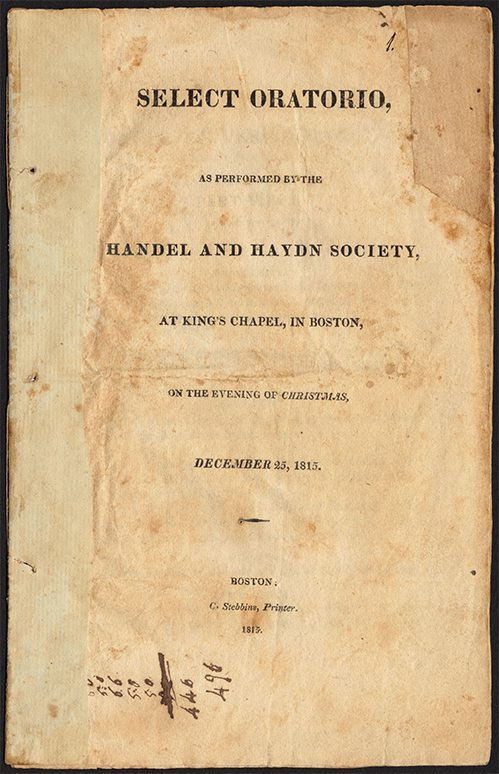
His achievements in music are equally commendable. He was the first president of the Psallonian Society, which was an organization for the “improvement of its member’s sacred melody.” He was also the first president of Boston’s Handel and Haydn Society, the oldest continuously performing music organization in the United States, and conductor of their first concert on December 25, 1815 at King’s Chapel. One thousand people attended that concert, which featured Haydn’s The Creation and several other works that included the “Hallelujah” chorus from Handel’s Messiah.
Michael Fratus, Student, Rhode Island College
Gallery


Thomas Smith Webb (1771-1819)
Thomas Smith Webb was born in Boston, Massachusetts on October 30, 1771 to Samuel Webb and Margaret Cookson, and was one of eight children. Married twice, his first wife was Martha “Patty” Hopkins. She died in 1807 but not before they had 3 children together. Their first child, Martha Washington Webb, was born in 1799 and died young in 1802. Their second child, Thomas Hopkins Webb, was born in 1801, later became a doctor and noted philanthropist, and lived until 1866. Their third child, Mary Jane Webb, was born in 1803 but also died young in 1817. In 1808 Webb married Mehitable (Hitty) Hopkins, the sister of Webb’s first wife, Martha. Thomas and Hitty had no children.
%20Landscape.jpg)
In his early years in Boston, Webb worked as a printer’s apprentice. He continued to work as a printer in Keene, New Hampshire and Cleveland, Ohio before he moved to Rhode Island in 1799. Even then he continued to travel back and forth from Rhode Island to Ohio. Although his trade was printing, he was considered by his contemporaries to be an exceptionally talented and intelligent man who involved himself in a number of different fields. He was a very important to the Freemasonry movement and was considered the foremost Masonic ritualist in the English-speaking world. Webb wrote Freemason’s Monitor or Illustrations of Masonry, a book that had a significant impact on the development of Masonic Ritual in the United States, and the York Rite in particular. Webb has been called the “Founding Father of the York and American Rite.”
In the late 1790s he helped form ‘The Providence Royal Arch Chapter’ of the Freemasons. He became the second Grand High Priest of the Grand Chapter of Rhode Island after the Arch combined with the state chapter. He remained at the head of that organization for eleven years. In 1802 the Grand Lodge of Rhode Island held several conferences, one of which was in Providence on February 26th, when the lodge’s constitution was revised. One of the committee members tasked with this revision was Brother Thomas Smith Webb.
His achievements in music are equally commendable. He was the first president of the Psallonian Society, which was an organization for the “improvement of its member’s sacred melody.” He was also the first president of Boston’s Handel and Haydn Society, the oldest continuously performing music organization in the United States, and conductor of their first concert on December 25, 1815 at King’s Chapel. One thousand people attended that concert, which featured Haydn’s The Creation and several other works that included the “Hallelujah” chorus from Handel’s Messiah.
Webb died in Cleveland, Ohio on July 6, 1819 after suffering a cerebral hemorrhage. He was originally buried in Cleveland, but the Rhode Island Lodge thought it would be fitting to move him to Providence to be buried in the West Burying Ground. When that cemetery later was converted to a park, his body was buried a third time, and he now rests in the North Burial Ground, on a plot given by the city, on which a marble obelisk was erected by the Grand Lodge. Each side of the shaft records one of his major accomplishments.
Michael Fratus, Student, Rhode Island College
Further Reading
Ridley, Jasper. The Freemasons: A History of the World’s Most Powerful Secret Society. New York: Arcade, 2002.
Tawa, Nicholas. From Psalm to Symphony: A History of Music in New England. Boston: Northeastern, 2001.

